The Bell
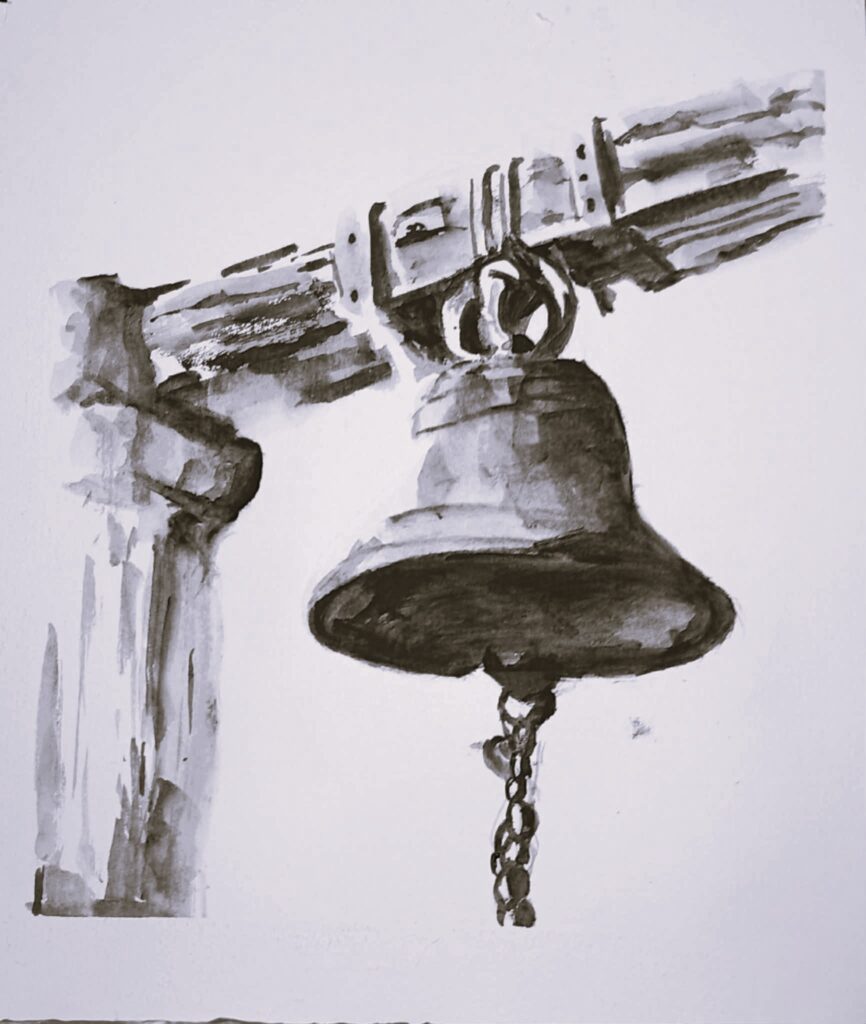
In small Greek villages, death rings a heavy, ancient bell.
Its sound moves through cobbled streets and stone houses. It settles in the leaves of old oaks and elms and slips into gullies and flowing streams. It reaches patched rooftops, jagged mountains, and into deep ravines. It seeps into kitchens, cafés, and taverns, announcing that death has visited this tiny place.
The bell sounds slowly, like dragging footsteps.
People stop. Heads lift from coffee cups, from fieldwork, from fruit picking. Their gaze shifts upward with a quiet, weighted curiosity. Who has death come for on this cold, grey day?
A deep breath is drawn. A small prayer is whispered.
Three fingers join and move quickly across the chest and shoulders in a cross. A familiar gesture of reverence. A gesture of reverence for the same eternity that gives life and calls it back, carried on the sound of the same heavy bell.
For a few brief moments, thoughts gather around one house, one name, one life taken. Roosters fall silent. Stray dogs stop barking. Sheep pause mid-call. The village holds a fragile stillness.
The bell carries its song across rooftops, over hills, and out toward the sea, bearing a life with it.
Here, people know death walks alongside life. They look upward, remain still, breathe their prayer, and then return to their day.
Mother
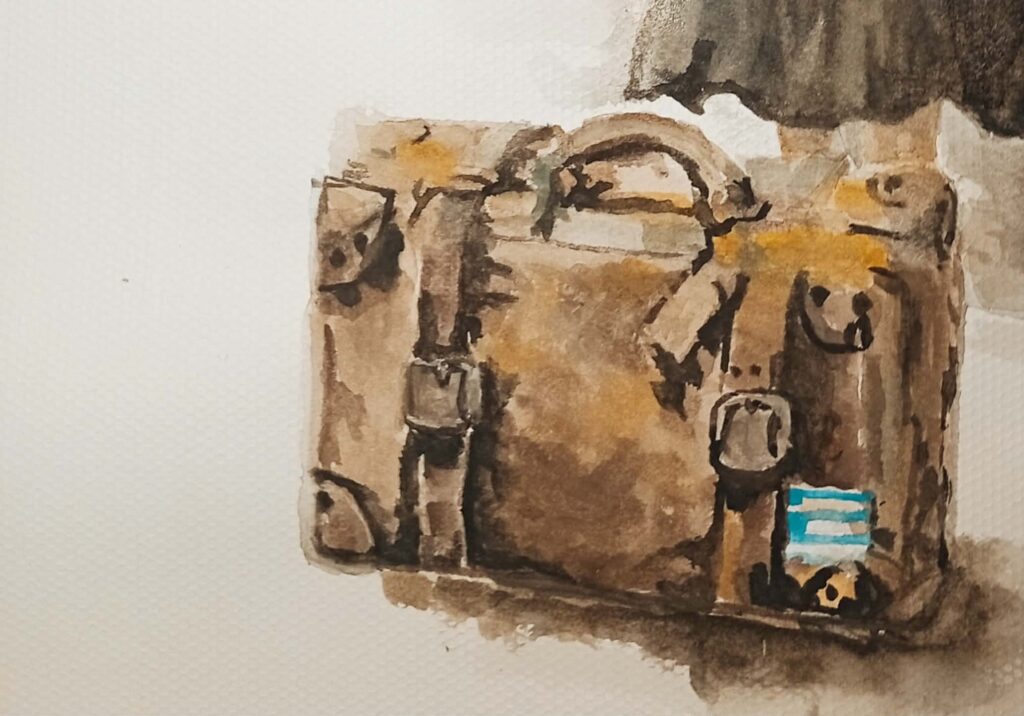
She left with a suitcase too small and still almost empty. Inside it lay a spare dress, a second blouse, and a black and white photograph of her and her siblings, wrapped in the same brown paper that once held beans for a family meal. The paper had already served its first purpose. Now it would serve another.
The village did not protest. It had learned how to fold absence into stone and continue. This was not the first departure born from an inescapable longing for life beyond the hills.
But this leaving carried a different weight. These were not young men pulled toward war or swallowed by anger. These were women in sensible shoes and Sunday skirts. Dry bread rolls pressed into their pockets. Letters clutched in their hands, the paper thinned by tears, promising a bed in a distant family member’s rented house, a position in a factory, a beginning born of need, not adventure.
Parents leaned close to whisper, “Don’t forget who you are.”
Brothers held on longer than usual.
In the new country, identity loosened quickly. Names bent under foreign tongues. Accents hardened or softened depending on the room. Memory grew sharp. The real danger lived there, in the quiet replay of courtyards and olive trees and the weight of a mother’s palm against the cheek.
To migrate required a quiet violence against one’s own roots. They lifted themselves from soil that knew their names and tried to press those roots into ground that resisted them. They accepted that their mothers would age in their absence. That their fathers would grow thinner. That olive trees would bear fruit without their hands to gather it.
There was numbness in leaving. Beneath it, a restrained anger. When counting mouths at the table, daughters were calculations. Their bodies were futures, their futures negotiable. Factories across oceans asked for hands. Villages asked for dowries and land. The arithmetic favoured departure.
Somewhere between the dock and the open water, they crossed a threshold. They were no longer daughters; they became the mothers of survival.
“I won’t forget,” they promised, their voices steady enough to soothe the ones who stayed behind.
On buses that rattled across dust, on ships that groaned through weeks of water, they repeated sewing, tapestry instructions and recipes to one another. Measurements without cups and instructions without paper. The words rose and fell with the movement of the sea. Carried outward, scattered across continents.
From these women came cities layered with memory. Kitchens thick with oregano and steam. Children who learned two lullabies before they learned to read. Grandchildren who would pronounce their names with softened consonants and inherited pride.
The diaspora began with a woman who stepped forward while everything familiar remained still.
She carried more than a small, half-empty suitcase. She carried continuity.
The Worry Beads – Komboloi
There was a time when men were expected to hold themselves together.
Publicly. Privately. Steadily. Without interruption.
They were allowed to work, carry, endure, and provide. Their role was to hold up families, fields, businesses, wars, debt, reputation, inheritance, and silence. Emotion existed, but it had no recognised place of release.
So it travelled into the hands.
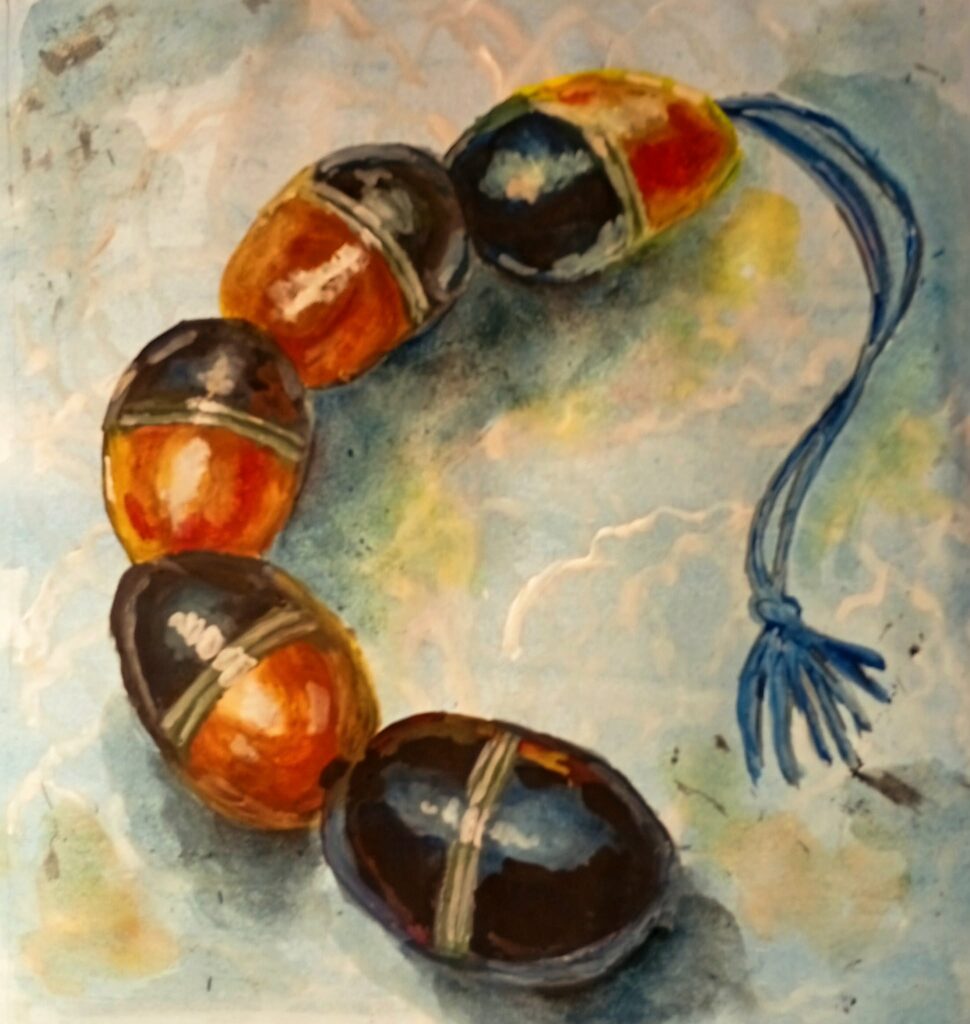
The worry beads, or komboloi, belonged to the inner life. A small loop of beads passing endlessly through the fingers, a quiet pacing of the nervous system, a pacing the body understood long before the mind learned its importance.
Click.
Slide.
Pause.
Click again.
The komboloi’s movement was so simple that it could disappear into the background of life. In cafés, in doorways, on construction breaks, in the space between one obligation and the next, you could see it. A steady string of worry being gently worn smooth.
The komboloi was meditation without permission, regulation without language, company without conversation.
Previous generations of men did not grow up with emotional vocabulary. They grew up with duty. Work became both career and identity. Value was earned through endurance. Rest carried suspicion. Doubt learned to disguise itself as effort.
There was little room for men to speak overwhelm out loud. Fear, loneliness, confusion, identity all moved inward. The body found its own way through.
The komboloi became a quiet intimacy.
With the beads in your hands, you could touch your worry without identifying it. You could soothe restlessness without confession when the inner world had no audience.
A komboloi was personal in a way that modern objects rarely are. It absorbed the warmth of one person’s skin, one person’s rhythm, one person’s seasons of dread, waiting, frustration, boredom, and hope. Over time, it learned your tempo. It understood how fast you moved when anxious, how slow when heavy, how erratic when thought grew crowded. It kept your secrets through friction.
Worry beads were never shared.
Only turned, again and again, by your own hand.
Click.
Slide.
Pause.
Click again.
Thresholds
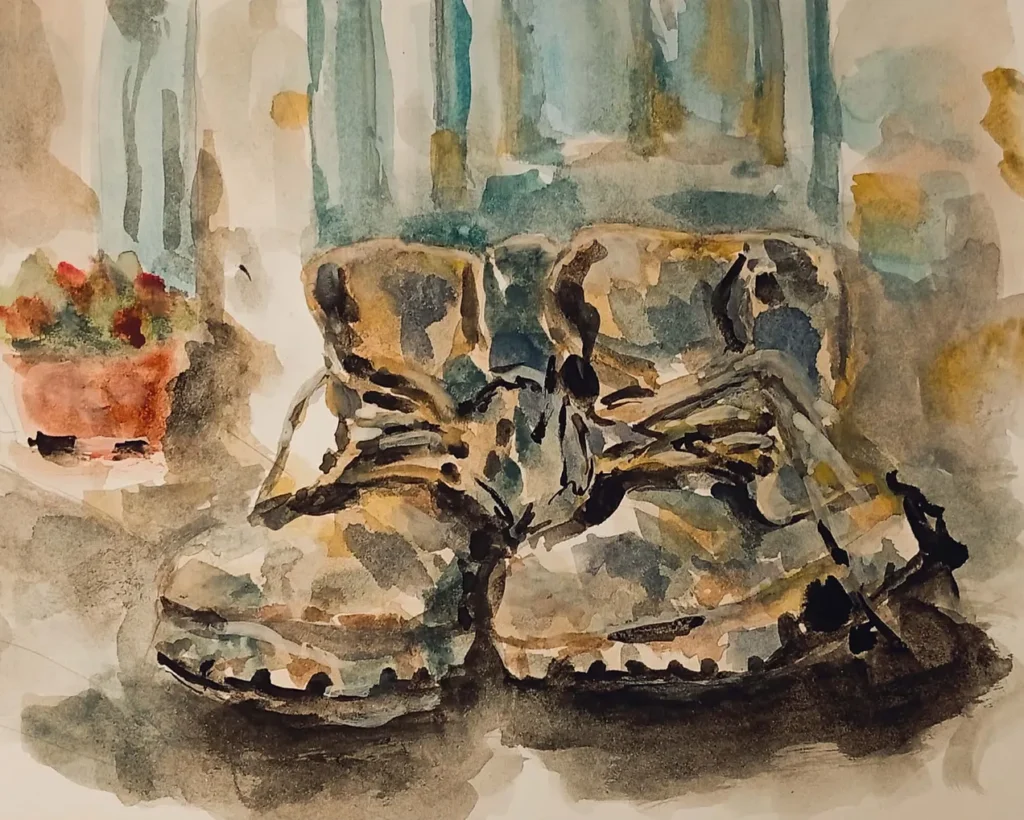
Leave your boots at the door.
This is the threshold, and labour is not allowed to enter here with you.
These rooms are sacred. Hold their sanctity like a shield against internal attack. You cannot wear your shoes through this door. Leave them where they belong, in another world where peace and intimacy do not live. Here is a place of quiet and closeness, and your boots do not belong.
Thresholds hold meaning. They are magic passages that move us between worlds. They carry us into rooms where masks can be dropped, where breath leaves the body in a long, heavy sigh. Thresholds mark our crossing into places where feet rest on coffee tables, where food dribbles onto shirts, where laughter fills rooms, poor manners are allowed, masks are thrown into corners with coats, and performances end.
In Greek village homes, shoes are left outside. You are welcome, my friend, as you are, but your shoes are not. There will be no carrying of dirt, sweat, labour, or fields into this sanctuary. This is the home, and the threshold is strong. Across it may pass only those who love, who quarrel, who know us. Here live the slippers that shuffle across worn rugs and polished tiles. Boots have no business entering this peace.
Boots live in fields. They thrive in fields. They carry dirt and heartache and labour like medals.
They protect tired, weathered feet. They withstand storms. They dodge snakes in tall grass and leave their marks in mud. They know weight. They know effort. They know endurance.
Do not bring them across the threshold. There will be time enough for boots again tomorrow.
Come in… welcome to my peace. Use my slippers, clean and worn. Boots do not belong to peace or respite. They do not belong to family dinners or warm fires. They do not belong to safety, or rainy days under thick blankets. They do not belong to quiet kitchens and soft light.
They belong on the other side of the threshold.
They belong to another world. There will be time enough for that world tomorrow.
Come in, come in.
Harehound
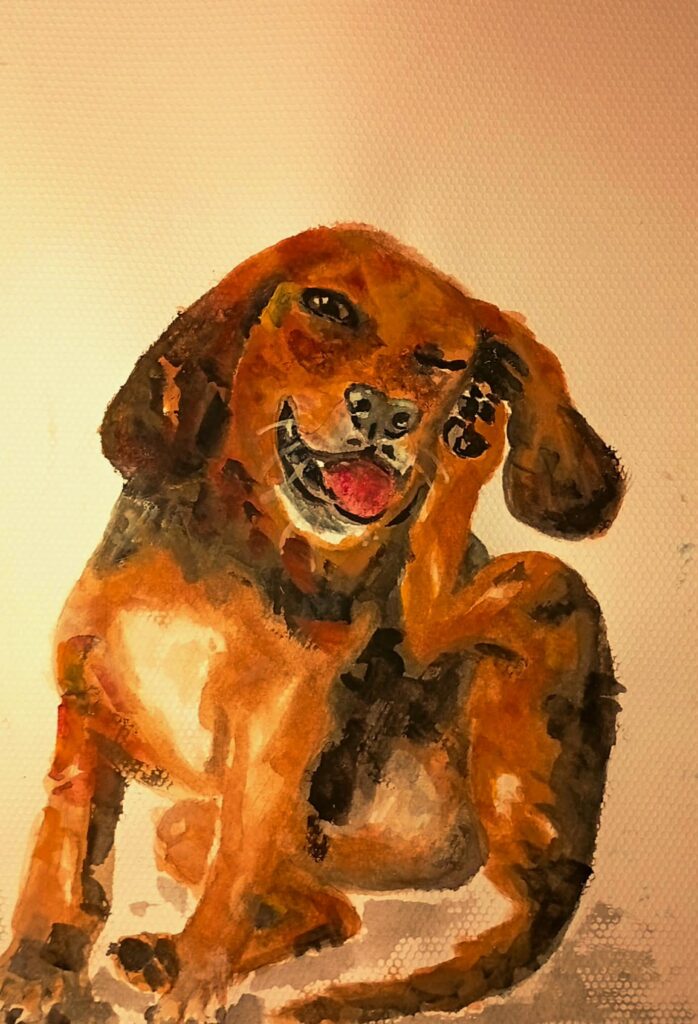
This is Pablo.
A harehound I found in an empty stone-paved alley during lockdown. Flea-bitten but cheerful, Pablo followed me home as though he knew me.
“What’s your name?” I asked, already falling in love.
After a hefty meal and several dramatic slurps of water, he replied, “Whatever you like.”
“I’m going to call you Pablo. You look artistic.”
With one final gulp of water and a shake of his tail, which rotated more like a helicopter blade than wagged back and forth, it was agreed. He was Pablo.
It did not take him long to ease into his new name.
We went to the vet. The vet and I were swaddled in masks and gloves. Pablo looked at us with open curiosity. As needles pricked him, his temperature was taken, and blood was drawn, Pablo never once blamed me for this shocking turn of events.
He blamed the vet.
This awful man who had clearly forced me and Pablo to wear a muzzle.
Pablo did not care for him at all.
“He’s a harehound. A gekka,” the vet said, sensing that he and Pablo would never be friends and wisely keeping his distance from both my possible infection and Pablo’s side-eye. “He’s definitely a harehound.”
As if that should mean something to me.
I did not care what he was. To me there was no need for labels on perfection.
We went home and I promised Pablo that it had all been for his own good. He seemed relieved when I tore off my mask and my face returned to its usual expression of joy.
He ate more. Drank more water. There was a cheese snack and some banana involved. All was well in the world.
Then came the bath.
He just knew that awful man in the white coat and blue paper muzzle had suggested it.
His short double coat covered my bathroom in a generous layer of red and black hair. Despite his suspicions, Pablo discovered he rather liked hot water and the curious pleasure of no longer needing to scratch.
More food. More water. A celebratory nap.
He curled up at my feet and fell in love with me too.
When a stray cat appeared, I asked that he do his best to override his instincts and accept the cat as a friend. He promised not to drag the cat around by the tail but made no commitment to friendship.
I thanked him for trying. I understood how difficult this must be for a harehound. I had done my research.
Harehounds are an ancient Greek breed, documented as having hunted small prey alongside the ancients. Known for their stubbornness and cleverness, they have used those traits to survive for millennia. Now they mostly roam free in the Greek countryside, though they have always been fond of human companionship. In the ancient world they were just as likely to sit beside philosophers as they were to hunt beside heroes.
Now my harehound hunts for my slippers and sits quietly breathing next to me while I paint or write. When I finish, I show him my art or read him my words. He seems entranced. Absolutely fascinated by everything I say and do.
He loves my art. It does not have to be good.
He loves living in a home where someone asks his opinion.
When I read to him, he smiles and his helicopter tail rotates with enthusiasm.
The cat, called Oscar by the way, yes, Oscar Wilde, shows complete indifference. Pablo is quick to point this out. He wants me to be very clear about who loves me most.
We go for walks. In small villages, leashes are largely unnecessary for friendly dogs. Unable to match his energy, I shuffle along while he runs ahead, pivots, runs back, then ahead again. Always circling me. Always alert in case I am attacked by chickens, donkeys, or worse, in case I discover another cat and attempt to bring that one home too.
Once, on such a walk, he brought me a squirrel.
My heart wrenched.
His eyes were wide, his tail spinning, so proud to bring me something of value. I explained that the squirrel was a free citizen of the forest and again asked that he override his instincts. He looked confused but agreed. I promised that if he put the squirrel down, I would allow him to take my slippers out for a walk next time.
Thereafter we were spotted around town, me in my black waterproof coat and Pablo happily trotting beside me with pink slippers in his mouth.
I am pleased to report that the squirrel survived and most likely warned all other small woodland creatures because, to my knowledge, Pablo was never tempted again.
One day Pablo scratched his ear.
I panicked.
Was it fleas again? An infection? A tragic relapse?
We raced to the vet. Pablo did his best to stage a riot. He offered the vet his most refined side-eye, barked at the assistant, then settled when I assured him there would probably be no needles, merely an ear and coat inspection.
He agreed reluctantly.
“What’s wrong?” the vet asked, keeping one cautious eye on Pablo.
“He was scratching his ear.”
“How often?”
“All the time!” I exclaimed dramatically. I took a breath, checked myself, and corrected to, “Sometimes.” I took another breath. “This morning,” I now pronounced sheepishly.
After a thorough examination, I was informed that Pablo was flea-free and infection-free. Pablo’s tail resumed its helicopter duties.
I remained pensive.
“Then why would he scratch?”
The vet looked at me kindly.
“Sometimes, Eleni, dogs just like to scratch.”
Pablo looked at me calmly, scratched once more for emphasis, and resumed disliking the vet.